July 14, 2026
PVC vs. Wood vs. Acoustic: Which Ceiling Panel Material Is Best?
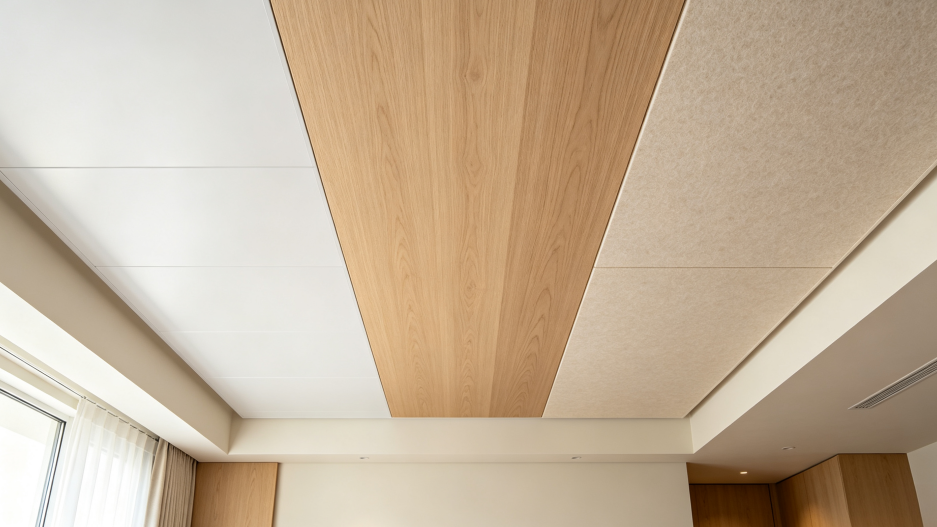
Introduction
Let’s be honest: most people don’t think about ceilings until something goes wrong. The ceiling is the fifth wall—often ignored, always present. But when you're specifying materials for a commercial building, a healthcare facility, an educational space, or even a high-end residential project, that ceiling becomes a critical decision point. It’s not just about covering up the structure above. It’s about acoustics. Fire safety. Durability. Maintenance. Cost. And increasingly, sustainability.
I’ve sat through enough project post-mortems where the ceiling material was the culprit—echo-filled conference rooms, sagging panels in humid environments, fire code violations that could have been avoided, or a beautiful wood ceiling that turned into a maintenance nightmare. The choice between PVC, wood, and acoustic ceiling panels isn’t just a matter of aesthetics. It’s a matter of getting the building to perform the way it’s supposed to.
This guide breaks down the three most common ceiling panel materials—PVC ceiling panels, wood ceiling panels, and acoustic ceiling panels (primarily mineral fiber and fiberglass)—across the metrics that actually matter. No fluff. No marketing hype. Just the data and the practical considerations you need to make an informed decision.
What You’re Actually Choosing Between
Before we get into the numbers, let’s clarify what we’re talking about.
PVC ceiling panels are made from polyvinyl chloride, a lightweight plastic that’s waterproof, easy to clean, and budget-friendly. You’ll find them in bathrooms, kitchens, basements, and anywhere moisture is a concern. They come in a variety of colors and finishes—some even mimic wood or metal—but they’re fundamentally a plastic product.
Wood ceiling panels range from engineered wood products like MDF to solid hardwoods and mass timber systems. They offer unmatched warmth and natural beauty. Perforated wood panels with acoustic backing can achieve impressive sound absorption, but solid wood reflects sound.Wood is also the most maintenance-intensive option and requires careful consideration in humid environments.
Acoustic ceiling panels—typically mineral fiber or fiberglass—are engineered specifically for sound control. They’re the workhorses of commercial construction: offices, schools, hospitals, theaters. Premium mineral fiber panels can achieve NRC ratings up to 0.90 and CAC ratings of 35 or higher.
Acoustic Performance: The Numbers That Matter
Acoustics are where these materials diverge most dramatically. If sound control is a priority—and in most commercial spaces, it should be—this is where you need to pay attention.
Sound Absorption (NRC)
Noise Reduction Coefficient (NRC) measures how much sound a material absorbs. An NRC of 0 means total reflection; 1.00 means total absorption.A ceiling system with an NRC below 0.50 is considered low performance; above 0.70 is high performance.
Here’s how the materials stack up:
Acoustic (Mineral Fiber/Fiberglass): This is the category leader. Premium mineral fiber panels from manufacturers like Armstrong achieve NRC up to 0.90.Some fiberglass products reach even higher. Standard mineral fiber tiles typically deliver NRC 0.55–0.75.
Wood: It depends entirely on the configuration. Solid wood reflects sound—NRC around 0.40–0.55.But perforated wood panels with acoustic backing can achieve NRC 0.55–0.70 in linear configurations, and up to 0.85 when properly engineered with infill panels.The performance comes from the complete assembly—wood surface, perforations, backing material, and air gap—not the wood alone.
PVC: This is where PVC falls short. NRC is typically 0.35–0.50.Because PVC is non-porous and solid, it reflects sound rather than absorbing it.For a noisy open-plan office, PVC is going to make things worse, not better.
Sound Blocking (CAC)
Ceiling Attenuation Class (CAC) measures how well a ceiling prevents sound from traveling through the plenum to adjacent spaces.This matters in multi-tenant buildings, hotels, and anywhere speech privacy is required.
Acoustic: Premium mineral fiber panels achieve CAC 35–42.A ceiling with CAC 35 or higher is considered high performance.
Wood: Solid wood panel systems typically achieve CAC 35–40.Perforated configurations block less sound.
PVC: CAC is typically below 25.Sound travels right through the plenum.
The Real-World Implication
An open-plan office needs both high NRC (to reduce noise within the space) and high CAC (to prevent conversations from traveling to neighboring areas).That dual requirement often points toward premium acoustic tiles or engineered wood/metal systems. A restaurant prioritizes NRC to control reverberation; CAC matters less.
Fire Safety: Non-Negotiable
Fire performance is where the differences become stark—and where code compliance can make or break your material choice.
Acoustic (Mineral Fiber/Fiberglass): These materials are inherently fire-resistant. Most mineral fiber panels achieve ASTM E84 Class A ratings (flame spread index 0–25, smoke developed index 0–450).They don’t melt or emit toxic fumes.
Wood: Wood is combustible. Even with fire-retardant treatments, wood ceilings require careful code compliance.Some engineered wood products achieve ASTM E84 Class A, but the flame spread index is typically higher than mineral fiber.For high-occupancy buildings, wood may require additional fire suppression systems.
PVC: This is where PVC gets tricky. Some PVC panels are rated Class A under ASTM E84.But here’s the catch: even fire-rated PVC can melt and emit toxic fumes when burned.In a fire, that’s a serious life-safety concern. Always request the ASTM E84 report—don’t just take the supplier’s word.
Durability and Lifespan
Ceilings are long-term investments. The material you choose today will be up there for years—or decades.
Acoustic (Mineral Fiber): Service life is typically 5–10 years in standard commercial environments.Mineral fiber is more susceptible to moisture and humidity than PVC, and can sag or discolor over time in damp conditions.However, premium products with humidity treatments perform better.
Wood: Service life ranges from 7 to 15 years depending on species, treatment, and environment.Wood is sensitive to termites, humidity, and UV exposure.In dry, climate-controlled interiors, wood can last longer. In humid spaces, it’s a liability.
PVC: PVC is the durability champion—10–15 years is typical, with some products claiming longer.It’s 100% waterproof, resistant to mold and mildew, and easy to clean.It won’t warp, sag, or discolor in humid conditions. For bathrooms, kitchens, and other wet environments, PVC is hard to beat.
Cost Considerations
Budget is always a factor. Here’s the rough breakdown:
PVC: $0.50–$0.75 per square foot for basic panels.The most affordable option upfront.
Acoustic (Mineral Fiber): $1.00–$3.00+ per square foot depending on NRC and CAC performance.Premium high-NRC panels cost more.
Wood: $10–$30 per square foot for engineered wood, $40–$50+ for solid hardwoods.The most expensive option by far.
But here’s the thing: upfront cost isn’t the whole story. A cheap ceiling can cost more over time if it needs frequent replacement, cleaning, or maintenance.
Comparison Table
Metric | PVC Ceiling Panels | Wood Ceiling Panels | Acoustic Ceiling Panels |
NRC (Sound Absorption) | 0.35–0.50 | 0.40–0.55 (solid) / 0.55–0.85 (perforated) | 0.55–0.90 |
CAC (Sound Blocking) | <25 | 35–40 | 35–42 |
Fire Rating | Class A possible, but melts/toxic fumes | Combustible; Class A with treatments | Inherently Class A |
Lifespan | 10–15 years | 7–15 years | 5–10 years |
Moisture Resistance | Excellent (waterproof) | Poor | Moderate |
Maintenance | Low—wipe clean | High—sealing, refinishing | Moderate—periodic cleaning |
Cost (per sq ft) | $0.50–$0.75 | $10–$50+ | $1.00–$3.00+ |
Best Applications | Bathrooms, kitchens, basements, wet areas | Lobbies, restaurants, residential, design-focused spaces | Offices, schools, hospitals, theaters, any noise-sensitive space |
Real-World Applications: Where Each Material Shines
PVC: The Moisture Solution
A commercial kitchen or a hotel bathroom needs a ceiling that can withstand steam, humidity, and frequent cleaning. PVC is the obvious choice here. It’s waterproof, mold-resistant, and can be wiped down with a damp cloth.In a luxury hotel in Basra, PVC ceilings required frequent replacement due to humidity—until they switched to aluminum acoustic panels.But for budget-conscious projects in wet environments, PVC remains a practical solution.
Wood: The Aesthetic Statement
Wood ceilings are about creating warmth and character. A restaurant, a boutique hotel lobby, or a high-end residential living room—these are spaces where wood’s natural beauty justifies the cost and maintenance. But you need to be honest about the trade-offs. Wood requires sealing, refinishing, and protection from moisture.In a dry, climate-controlled space, it can be stunning. In a humid environment, it’s a risk.
Acoustic: The Performance Standard
Open-plan offices, conference rooms, schools, hospitals, and theaters—these spaces live or die by their acoustics. Premium acoustic ceiling panels with NRC 0.85–0.90 and CAC 35+ are the industry standard for good reason.They absorb sound within the space and block it from traveling to adjacent areas.
A Case Study: The Abu Dhabi Theater
Let’s look at a real project. The Abu Dhabi Theater needed a ceiling system that could deliver both fire safety and sound isolation. The solution? Armstrong steel ceilings.The system achieved an STC of 42 and an NRC of 0.79.
Why steel rather than wood or PVC? Steel is non-combustible—critical for a high-occupancy venue. The perforated steel panels with acoustic infill delivered the NRC needed for speech clarity and the STC needed to prevent sound from bleeding between spaces. The system offered 90–120 minutes of fire resistance.Wood would have been a fire risk. PVC would have melted and emitted toxic fumes.
This is a textbook example of matching the material to the performance requirements, not just the budget or the aesthetic.
The Sustainability Angle
Sustainability is becoming a non-negotiable in many projects.
Acoustic mineral fiber panels typically contain recycled content—often recycled paper, mineral wool, and other natural binders.They’re also recyclable at end-of-life.
Wood is renewable and biobased. Armstrong’s WOODWORKS MicroPerforated panels, for example, are made from 100% USDA Biobased Content.But wood’s sustainability depends on responsible forestry and sourcing.
PVC is the least sustainable option. It’s non-biodegradable, derived from fossil fuels, and difficult to recycle.For projects with strict sustainability requirements, PVC is increasingly being phased out.
FAQ
Q: Can I use wood ceiling panels in a bathroom?
A: Generally, no. Wood is sensitive to humidity and moisture. In a bathroom, wood can warp, swell, or develop mold over time.If you want the look of wood in a wet area, consider wood-look PVC or metal panels instead.
Q: Are PVC ceiling panels fire-rated?
A: Some PVC panels achieve ASTM E84 Class A ratings.However, even fire-rated PVC can melt and emit toxic fumes when burned.For high-occupancy buildings or spaces with strict fire codes, mineral fiber or metal acoustic panels are safer choices.
Q: What NRC do I need for an office?
A: For good speech privacy and noise control in an open-plan office, aim for NRC 0.70 or higher.Premium acoustic ceiling panels achieve 0.85–0.90. You’ll also want CAC 35 or higher to prevent sound from traveling through the plenum.
Q: Which material lasts the longest?
A: PVC typically lasts 10–15 years and is highly durable in wet environments.Wood can last 15+ years in dry, climate-controlled spaces but requires maintenance. Acoustic mineral fiber typically lasts 5–10 years.
Q: Is wood ever a good acoustic choice?
A: Yes—but only with perforations and acoustic backing. Perforated wood panels with infill can achieve NRC up to 0.85.Solid wood reflects sound and is a poor choice for acoustic control.
Final Thoughts
Here’s the bottom line.
If your priority is moisture resistance, low cost, and easy maintenance, PVC is a practical choice—but only in spaces where acoustics and fire safety aren’t critical.
If your priority is aesthetics, warmth, and natural beauty, wood is unmatched—but you need to budget for maintenance and accept its limitations in humidity and fire performance.
If your priority is acoustic performance, fire safety, and long-term value, acoustic ceiling panels—mineral fiber or fiberglass—are the professional’s choice. They’re the workhorses of commercial construction for a reason.
The right material depends entirely on the space, the use case, and the performance requirements. There’s no universal “best.” There’s only what’s best for your project.
Choose accordingly.